Software Development
Blockchain Technology: How It Works, Uses, Benefits & Future
Learn what blockchain technology is, how blockchain works, its key features, applications, security, benefits, limitations, smart contracts, and future.
How Does a Blockchain Work?
Although different blockchain networks work differently, the basic process is relatively straightforward.
When someone creates a transaction, it is first broadcast to the network. Participating nodes receive the transaction and check whether it follows the rules of the blockchain.
Valid transactions can then be grouped into a block.
The network's consensus mechanism determines how that block becomes part of the accepted blockchain history.
Figure: A blockchain links blocks together using cryptographic information, creating a chronological chain of records. Source: NIST.
Once a block has been accepted, it becomes part of the growing chain. The next block contains information connecting it to the previous one, making unauthorized changes to historical records detectable.
What Is a Cryptographic Hash?
A cryptographic hash is one of the key technologies behind blockchain.
It takes information as input and produces a fixed-length digital representation. If the original information changes, the resulting hash also changes.
This makes hashing useful for connecting blocks and detecting changes in previously recorded information.
Figure: A simplified visualization of how cryptographic hashes connect blocks in a blockchain.
The important point is that the hash is not simply a password or encryption mechanism. It is a mathematical fingerprint of information.
Proof of Work and Proof of Stake
Blockchain networks need a mechanism for agreeing on which transactions should become part of the official chain.
Two of the best-known approaches are Proof of Work and Proof of Stake.
Proof of Work relies on computational work, while Proof of Stake uses participants who commit assets according to the network's protocol.
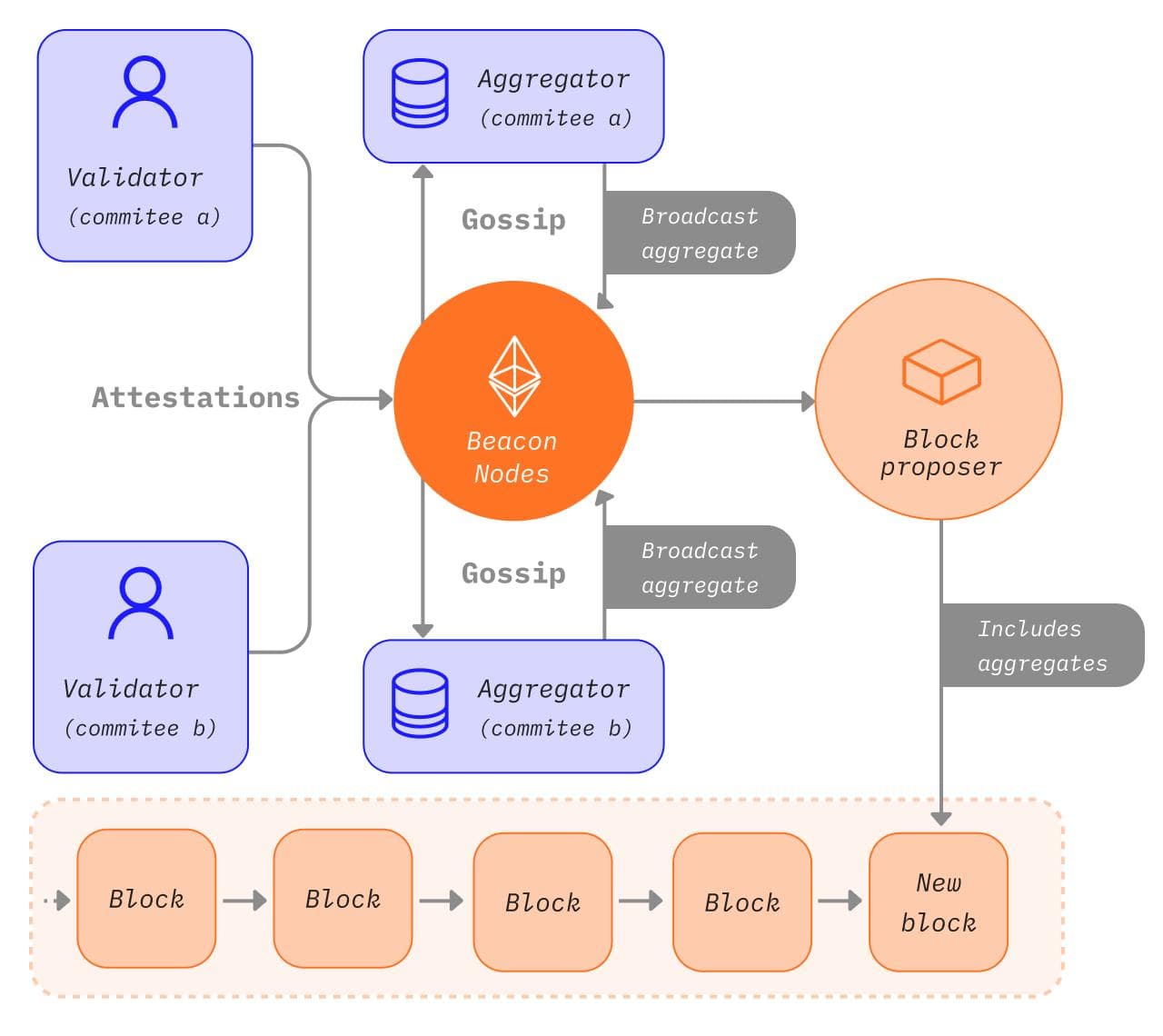
Figure: Ethereum's official documentation illustrates the architecture behind its Proof-of-Stake-based network.
Ethereum's transition from Proof of Work to Proof of Stake demonstrated that major blockchain networks can fundamentally change their consensus architecture.
Blockchain in Supply Chains
Blockchain can also be used outside cryptocurrency.
Consider a product moving through a global supply chain.
The manufacturer records its production. A logistics company records transportation. A warehouse records arrival. A distributor records another transfer.
Each participant needs reliable information about what happened before the product reached them.
Figure: Blockchain can provide a shared record of events across different participants in a supply chain.
Instead of maintaining completely separate records, participating organizations can use a shared blockchain-based system to record selected events and improve traceability.
Blockchain and Digital Assets
Blockchain also introduced a new way of representing digital ownership.
Cryptocurrencies are one example.
NFTs are another.
Tokenized assets provide another possibility.
Figure: Blockchain networks can represent different types of digital assets through tokens and smart contracts.
However, a token's existence on a blockchain does not automatically determine its legal meaning. Ownership rights, licensing and other legal relationships depend on the specific system and applicable laws.Write your article here...
About the Author
Aslam Hossain is the founder and editor of Vishtech Blog, creating accessible technology content about AI, software, startups, robotics, cybersecurity, and future innovations.
Comments
Article text preview: How Does a Blockchain Work? Although different blockchain networks work differently, the basic process is relatively straightforward. When someone cre