Biomedical Engineering
How Memory Works: The Science of Learning, Memory Formation, and the Human Brain #part1
Discover how the human brain creates, stores, and retrieves memories. Learn the science of memory formation, learning, neuroplasticity, and brain health in this evidence-based educational guide.
By Aslam Hossain · July 22, 2026 · 14 min read
Sponsored by Aslam Hossain. Hi I am aslam hossain. co founder and ceo of vishtech
Premium article: membership access controls are enabled for this content architecture.
How Memory Begins
Imagine waking up one morning and realizing you cannot remember your own name. The faces of your family feel unfamiliar, your favorite songs no longer trigger emotions, and the skills you mastered over years—reading, writing, driving, or speaking a language—have simply vanished. Although this scenario is rare, it highlights one of the most extraordinary abilities of the human brain: memory.
Memory is far more than the ability to recall facts or recognize familiar faces. It is the biological foundation of learning, identity, creativity, and decision-making. Every conversation you have, every book you read, every mistake you learn from, and every achievement you celebrate depends on your brain's remarkable capacity to transform fleeting experiences into lasting knowledge.
Memory begins long before information is consciously remembered. Every second, your eyes, ears, nose, skin, and tongue collect enormous amounts of sensory information from the surrounding world. These signals travel through specialized sensory neurons to different regions of the brain, where they are analyzed in fractions of a second. Only a small portion of this information is considered important enough to become part of your memory.
Figure 1. Sensory organs continuously collect information from the environment and transmit it to the brain. These incoming signals represent the first stage of memory formation, where the nervous system determines which experiences deserve further processing.
Modern neuroscience has revealed that memory is not stored like files inside a computer. Instead, memories emerge from billions of neurons communicating through trillions of microscopic junctions known as synapses. Every new experience activates unique networks of neurons that exchange electrical impulses and chemical messengers called neurotransmitters.
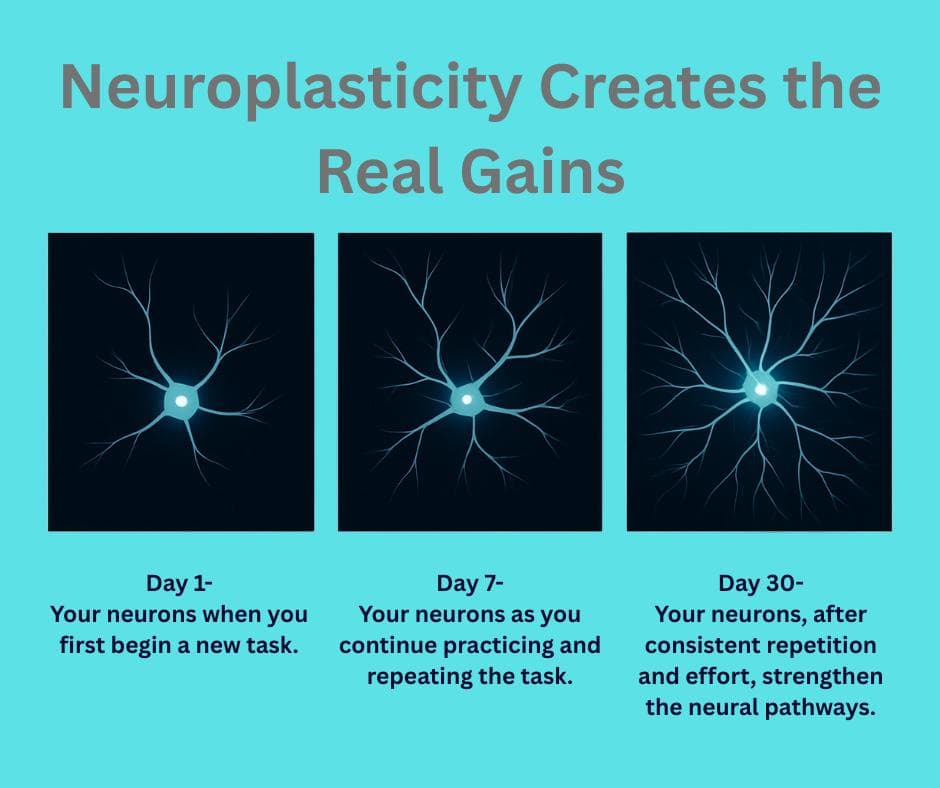
Repeated activation of the same neural pathways strengthens these synaptic connections through a process called synaptic plasticity. This biological mechanism allows experiences to become stable memories, making future recall faster and more reliable.
Figure 2. Neurons communicate across specialized junctions called synapses using electrical impulses and neurotransmitters. Repeated communication strengthens these neural pathways, forming the biological basis of learning and long-term memory.
Rather than functioning as a static storage device, the human brain continuously reorganizes itself throughout life. This remarkable ability, known as neuroplasticity, enables children to learn languages, students to master complex subjects, musicians to refine their skills, and adults to adapt to new experiences. Every meaningful interaction leaves a subtle biological imprint, gradually reshaping the brain's neural architecture.
Understanding how memory begins provides the foundation for understanding every aspect of human learning. In the following section, we will examine how the brain converts these early sensory experiences into short-term, working, and long-term memories that shape our knowledge, skills, and identity.
The Journey from Sensation to Memory
Every moment of your life begins as a stream of sensory information. The aroma of freshly brewed coffee, the laughter of a friend, the warmth of sunlight on your skin, or the sight of a colorful sunset all enter your nervous system in the same way—as electrical signals generated by specialized sensory receptors.
Yet only a tiny fraction of these experiences will become memories.
The human brain receives an astonishing amount of information every second. Scientists estimate that our sensory organs continuously collect far more data than the conscious mind can process. If every sound, image, smell, and touch were stored permanently, everyday thinking would become nearly impossible. Instead, the brain acts as a highly efficient biological filter, selecting what deserves attention while discarding information that has little immediate value.
This filtering process begins almost instantly after sensory information reaches the brain. Networks of neurons compare new information with previous experiences, emotional significance, current goals, and environmental context. Experiences that are repeated, emotionally meaningful, surprising, or important for survival are much more likely to continue along the pathway toward long-term memory.
Figure 3. Before a memory can be formed, sensory information passes through multiple stages of processing. The brain continuously filters incoming signals, prioritizing information that is meaningful, emotionally important, or relevant to current goals.
One of the most remarkable aspects of memory formation is that the brain does not simply record reality like a video camera. Instead, it actively interprets and organizes information. Your previous experiences, expectations, emotions, and attention all influence how an event is remembered.
For example, two people attending the same lecture may remember completely different details. One student may recall the scientific explanations, while another remembers an inspiring story told by the speaker. The event was identical, but each brain selected different pieces of information based on personal interests and attention.
This explains why attention is one of the most important ingredients of learning. Information that never receives focused attention rarely progresses beyond the earliest stages of memory formation. In contrast, concentrated attention increases communication between neurons, making it more likely that new knowledge will be encoded and strengthened.
Scientists often describe this stage as encoding—the process of transforming sensory experiences into neural representations that the brain can organize and store. During encoding, billions of neurons work together, exchanging electrical impulses and neurotransmitters to create unique activity patterns representing a particular experience.
Figure 4. During memory encoding, networks of neurons become active together while the hippocampus helps organize newly acquired information. Repeated neural activity strengthens synaptic connections, increasing the likelihood that an experience will become a lasting memory.
The hippocampus, located deep within the temporal lobe, plays a central role during this stage. Rather than serving as a permanent storage location, it functions as a biological coordinator. It links together different pieces of an experience—what you saw, heard, felt, and understood—into a coherent memory that can later be distributed across the cerebral cortex.
Researchers have discovered that memories formed through active engagement are generally stronger than those formed through passive observation. Asking questions, solving problems, discussing ideas, and applying new knowledge activate broader neural networks than simply reading or listening. The more pathways involved in learning, the more opportunities the brain has to reinforce those connections.
Emotion also has a powerful influence on memory. Events associated with joy, fear, surprise, or excitement often become especially vivid because emotional centers of the brain, particularly the amygdala, interact closely with memory-processing regions. This is why many people can vividly remember where they were during a major historical event or an important personal milestone years after it occurred.
By the time an experience reaches the end of the encoding stage, it has already begun to reshape the brain. Tiny changes in synaptic strength, patterns of neural activity, and communication between different brain regions create the biological foundation for future recall. These microscopic changes may seem insignificant individually, but together they allow humans to build languages, develop expertise, preserve lifelong memories, and continuously adapt to an ever-changing world.
In the next section, we will explore how these newly encoded experiences are transformed into short-term, working, and long-term memory, and why some memories disappear within seconds while others remain with us for a lifetime.
The Different Types of Memory: From a Fraction of a Second to a Lifetime
Have you ever glanced at a phone number, remembered it just long enough to dial it, and forgotten it moments later? Or perhaps you still remember the name of your first school teacher decades after graduation. These two experiences may seem similar, but they rely on very different memory systems within the brain.
Memory is not a single biological process. Instead, neuroscientists describe it as a collection of specialized systems that work together to process information over different time scales. Some memories exist for only a fraction of a second, while others can remain accessible for an entire lifetime. Each type serves a unique purpose, helping us navigate everyday life efficiently.
The journey of a memory usually begins with sensory memory, progresses into short-term or working memory, and, if the information is meaningful enough, becomes part of long-term memory. Understanding these stages reveals why we remember certain experiences so vividly while forgetting countless others.
Figure 5. Human memory operates as a sequence of interconnected systems. Sensory memory briefly captures incoming information, working memory processes what deserves attention, and long-term memory preserves important experiences for future recall.
Sensory Memory: The Brain's First Impression
Every second, your senses collect enormous amounts of information from the surrounding world. Your eyes detect changing light, your ears capture vibrations in the air, your skin senses temperature and pressure, while your nose and tongue constantly analyze chemical molecules.
Most of this information disappears almost immediately.
Sensory memory acts as the brain's first holding area, retaining raw sensory information for only a brief moment—typically less than a second for visual information and a few seconds for sounds. This short-lived storage gives the brain enough time to determine whether incoming information deserves further processing.
Imagine watching a shooting star streak across the night sky. Even after it disappears, you may briefly "see" its trail. This phenomenon occurs because visual sensory memory, often called iconic memory, temporarily preserves the image before it fades. Similarly, echoic memory allows you to remember the last few seconds of a conversation, enabling you to understand speech even if your attention briefly drifts.
Without sensory memory, the world would appear as disconnected fragments rather than a smooth and continuous experience.
Figure 6. Sensory memory briefly preserves visual and auditory information, allowing the brain to integrate rapidly changing sensory signals into a continuous perception of the world.
Short-Term Memory: Holding Information for the Present
Once information captures your attention, it enters short-term memory, where it can be retained for several seconds. Unlike sensory memory, which passively receives information, short-term memory temporarily stores information that is actively being used.
For example, if someone tells you a six-digit verification code, you can usually remember it long enough to enter it into your phone. However, unless you repeat it or connect it with existing knowledge, the information quickly fades.
Scientists estimate that short-term memory has a limited capacity. Although the exact number varies among individuals, it can generally hold only a small amount of information at one time. This limitation explains why long lists of unfamiliar numbers or words are difficult to remember without repetition or organization.
To overcome this limitation, the brain often groups related information into larger, meaningful units—a strategy known as chunking. Instead of remembering ten separate digits individually, we naturally organize them into smaller groups, making recall much easier.
Working Memory: The Brain's Mental Workspace
While short-term memory temporarily stores information, working memory actively manipulates it. Working memory functions like the brain's mental workspace, allowing us to solve problems, understand language, make decisions, and plan future actions.
Imagine solving a mathematical equation in your head. You must temporarily remember numbers, perform calculations, compare intermediate results, and update your answer continuously. All of these operations depend on working memory.
Similarly, reading this article requires working memory. As you move from one sentence to the next, your brain continuously connects new ideas with earlier information, allowing the entire explanation to make sense.
Researchers have found that the prefrontal cortex, located at the front of the brain, plays a major role in coordinating working memory. Rather than acting alone, it communicates with many other brain regions, integrating information from vision, language, attention, and long-term memory.
Figure 7. Working memory relies heavily on the prefrontal cortex, which temporarily stores and manipulates information needed for reasoning, decision-making, language comprehension, and problem-solving.
Long-Term Memory: Building a Lifetime of KnowledgeSome experiences become so meaningful that they are preserved for months, years, or even an entire lifetime. These memories form the foundation of our knowledge, personality, relationships, and identity.
Long-term memory has an extraordinary capacity. Unlike short-term memory, scientists have not identified a clear upper limit to the amount of information it can store. Throughout life, the brain continuously strengthens, reorganizes, and integrates new memories into existing networks.
Long-term memory itself includes several categories. Explicit memories involve information that can be consciously recalled, such as historical facts, personal experiences, or vocabulary words. Implicit memories, on the other hand, influence behavior without conscious awareness, including habits, motor skills, and learned routines such as riding a bicycle or typing on a keyboard.
Although these categories rely on different neural circuits, they work together seamlessly in everyday life. Every conversation, every skill, and every meaningful experience reflects the coordinated activity of multiple memory systems operating simultaneously.
By understanding these different forms of memory, we gain a deeper appreciation of how the brain transforms fleeting sensory experiences into lasting knowledge. In the next section, we will explore how neurons physically strengthen their connections through synaptic plasticity and neuroplasticity, revealing how repeated learning literally reshapes the structure of the human brain.
How the Brain Stores Memories: From Short-Term Experiences to Lifelong Knowledge
Have you ever wondered why you can still remember your first day at school, your childhood home, or the excitement of learning to ride a bicycle, even though these events happened years ago? At the same time, you may struggle to remember what you had for lunch three days ago.
This remarkable difference reveals one of the greatest mysteries of the human brain: not every memory follows the same journey.
For a memory to survive beyond a few seconds or minutes, it must undergo a biological transformation known as memory consolidation. During this process, temporary neural activity is gradually converted into stable, long-lasting changes within the brain. Rather than storing information immediately, the brain carefully strengthens and reorganizes neural connections until the experience becomes a permanent part of its vast memory network.
Scientists now understand that this transformation depends on millions of neurons working together. Every meaningful experience leaves behind subtle biological changes that can persist for years or even a lifetime.
Figure 8. Memory consolidation is the biological process through which temporary experiences are transformed into long-term memories. The hippocampus coordinates this process before information becomes widely distributed throughout the cerebral cortex.
The Hippocampus: The Brain's Memory Organizer
Deep inside each side of the brain lies a small, curved structure called the hippocampus. Although it occupies only a tiny portion of the brain, it performs one of the most important tasks in human cognition.
The hippocampus does not permanently store every memory. Instead, it acts as an organizer and coordinator, linking together different pieces of an experience into a meaningful whole.
Imagine attending your graduation ceremony. At that moment, your brain processes countless details simultaneously:
- The faces of your classmates
- The sound of applause
- The color of your graduation gown
- The emotions you experienced
- The location of the ceremony
- Conversations with friends and family
Each of these details is processed by different regions of the brain. The hippocampus temporarily binds them together, allowing you to remember the event as one complete experience rather than a collection of unrelated fragments.
Without this remarkable coordination, memories would lose their context and become difficult to retrieve accurately.
Figure 9. The hippocampus serves as a central coordinator during memory formation, linking visual, auditory, emotional, and spatial information into unified experiences before long-term storage.
Synapses Become Stronger Through Experience
Every time you practice a skill or recall information, communication between certain neurons becomes more efficient.
This strengthening occurs at tiny junctions called synapses, where one neuron communicates with another using electrical impulses and chemical messengers known as neurotransmitters.
When the same neural pathway is activated repeatedly, the synapse undergoes structural and chemical changes. More neurotransmitter receptors may develop, communication becomes faster, and the connection grows increasingly reliable.
Scientists refer to this long-lasting strengthening as Long-Term Potentiation (LTP), one of the most widely studied biological mechanisms of learning and memory.
Although countless molecular processes contribute to memory formation, LTP demonstrates an essential principle of neuroscience: the more frequently neurons communicate together, the stronger their connection becomes.
This explains why repeated practice improves performance. Whether learning mathematics, speaking a foreign language, or playing the piano, repetition gradually strengthens the neural circuits responsible for those skills.
Figure 10. During long-term potentiation, repeated neural activity strengthens synaptic connections by increasing communication efficiency between neurons. This process forms one of the biological foundations of learning and long-term memory.
Sleep: The Brain's Night Shift
Many people assume that learning stops when they fall asleep. In reality, some of the brain's most important memory processes occur during sleep.
While you rest, the brain remains highly active. Networks of neurons repeatedly reactivate experiences from the day, strengthening important neural pathways while removing unnecessary information.
Researchers have shown that adequate sleep significantly improves learning, problem-solving, and memory retention. Students who sleep well after studying generally remember information better than those who stay awake throughout the night.
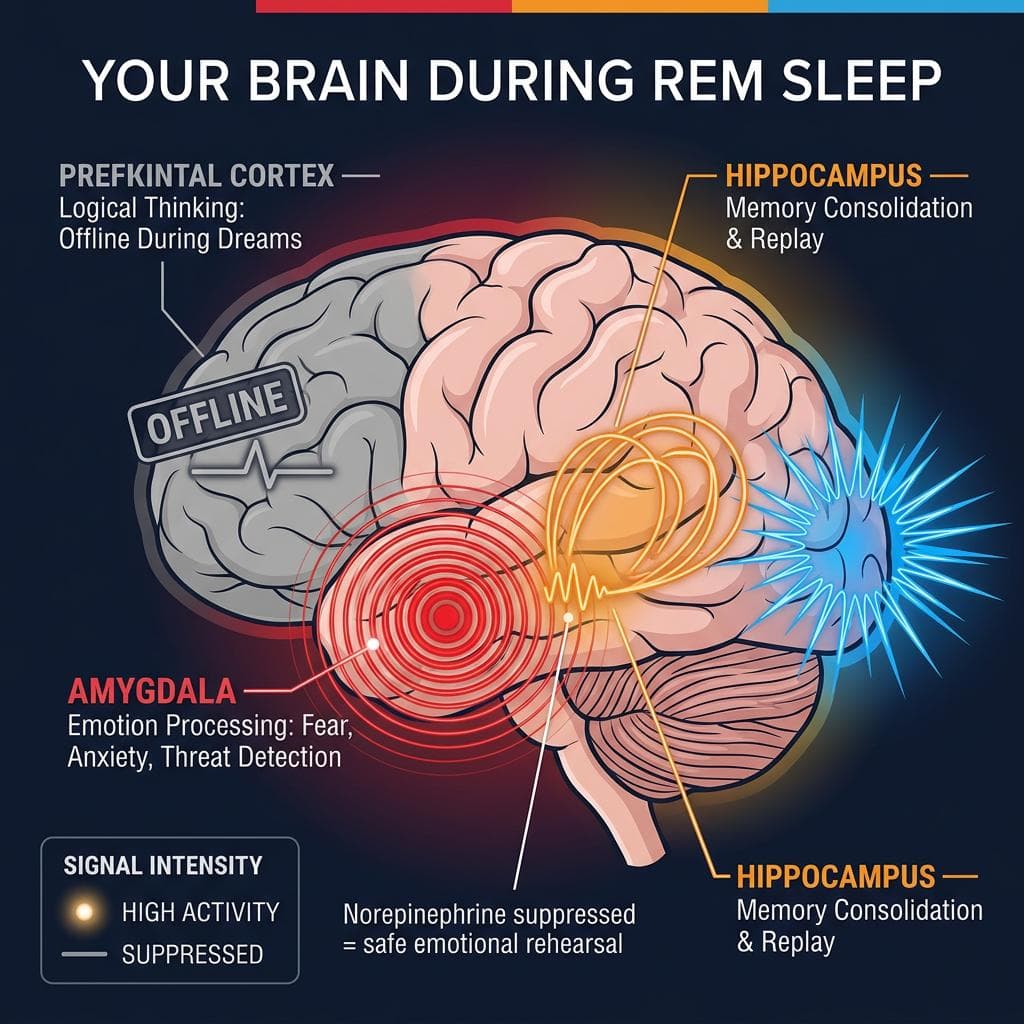
Different stages of sleep contribute to different types of memory. Deep sleep helps strengthen factual knowledge, while REM (Rapid Eye Movement) sleep plays an important role in emotional learning, creativity, and integrating complex experiences.
This explains why a difficult concept often feels easier to understand after a good night's sleep. Your brain has continued organizing and reinforcing the information even while you were unconscious.
Figure 11. During sleep, the brain actively consolidates memories by replaying patterns of neural activity, strengthening important connections, and integrating new knowledge with existing information.
Building a Lifetime of KnowledgeMemory is not created in a single moment. Instead, it is the result of countless biological processes working together over time.
Every book you read, every conversation you have, every challenge you overcome, and every new skill you practice gradually reshapes the architecture of your brain. Neurons establish stronger connections, new pathways emerge, and complex networks develop through continuous learning and experience.
Rather than functioning as a passive storage device, the human brain is a living system that constantly reorganizes itself. Every meaningful experience slightly changes its structure, allowing us to adapt, grow, and accumulate knowledge throughout our lives.
Understanding how memories become permanent helps explain why education, repetition, attention, emotional engagement, and healthy sleep are all essential for effective learning. These everyday habits influence the microscopic biological changes that determine whether today's experiences will still be remembered years from now.
In the next section, we will explore why we forget, examining the biological mechanisms behind memory loss, forgetting, interference, and how the brain decides which memories to keep and which to discard.
Article text preview: How Memory Begins Imagine waking up one morning and realizing you cannot remember your own name. The faces of your family feel unfamiliar, your favori